
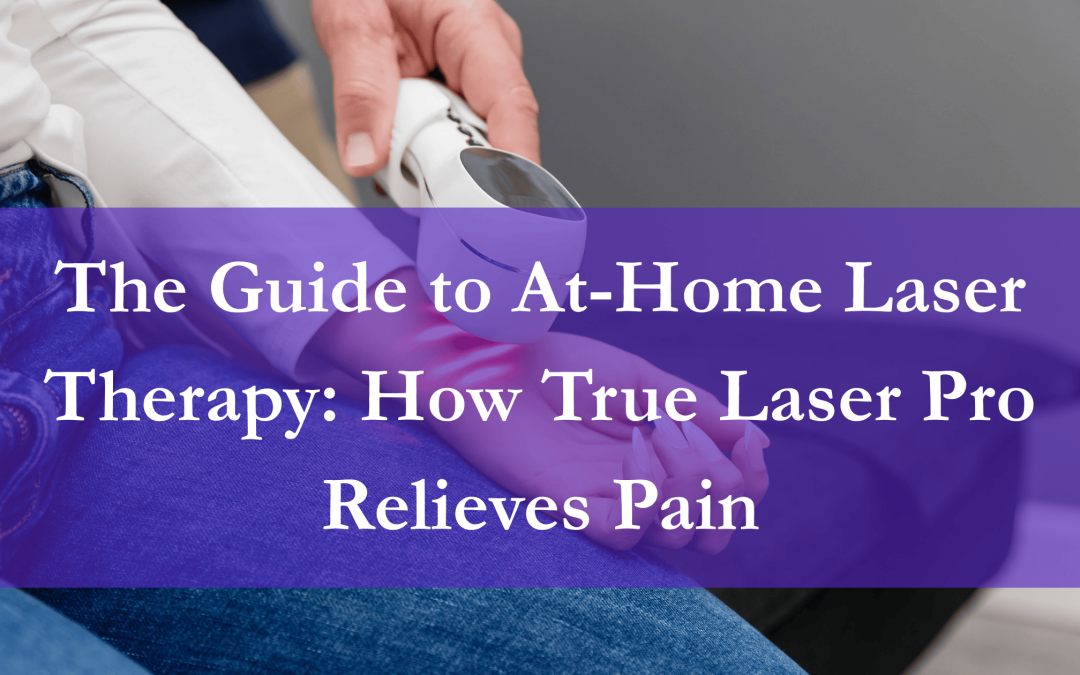
Understanding At-Home Laser Therapy
At-home laser therapy has quickly become one of the most searched solutions for people seeking real support for pain, recovery, and overall wellness without relying on medications or invasive procedures. As interest grows, so does confusion. The market is filled with devices labeled “red light therapy,” yet these products vary widely in how they function and what results they can realistically deliver. Red light therapy works well for general superficial stimulation, mild pain, muscle soreness and even with skin toning.
If you’re trying to understand what laser therapy actually is, how it works inside the body, and why True Laser Pro was designed specifically for safe and effective home use, this guide will walk you through the essentials in a clear, practical way.
What Is Cold Laser Therapy (Photobiomodulation)?
Cold laser therapy, also known as low-level laser therapy (LLLT) or photobiomodulation, uses specific wavelengths of light to support cellular activity and energy. Unlike surgical or heat-based lasers used for cutting or ablation, cold laser therapy is non-thermal. It does not burn or damage tissue.
Instead, it delivers light energy that cells can absorb to create immediate energy and heal tissues faster. The purpose is to support the body’s natural repair and regulation processes by improving cellular performance, particularly in tissue affected by inflammation, trauma, overuse, or chronic strain.
Understanding the Synergy of Lasers and Electrical Stimulation
At its core, the combination of dual-wavelength laser therapy and electrical stimulation works so well because it supports the body through multiple communication pathways at the same time.
The body doesn’t heal using one signal alone. It heals through:
- Laser light
- Electric signaling
- Enhanced bio-chemistry
- Nerve signaling
- Cell-to-cell communication
When laser therapy and gentle electrical stimulation are used together, they don’t compete, they reinforce one another for a synergist bio-stacking experience.
Why Mitochondria Matter
To understand why laser therapy feels different from many wellness tools, it helps to look at mitochondria in the cell membrane.
Mitochondria are often called the “power plants” of the cell because they produce ATP the energy currency your body relies on for tissue repair, nerve signaling, muscle function, and immune activity. Photobiomodulation is closely associated with mitochondrial support because targeted light energy can help optimize mitochondrial activity. This allows the cells and the nervous system to communicate at a higher rate. You cannot have healing without proper nervous system communication.
When cells have improved energy availability, many downstream processes such as recovery, tissue regeneration, and inflammation regulation will function more efficiently. This is why laser therapy isn’t just about relieving pain and muscle soreness; it’s about supporting cellular performance at a foundational level to rehabilitate the system.
Using a cell phone as an example, the True Laser brings the nerve signal from 1-Bar after acute or chronic trauma back up to 5-bars allowing optimal feedback from the treating area to the brain and then back down.
What Makes True Laser Pro Different for Home Use
True Laser Pro was designed around this cellular-support model, with an important distinction: it uses focused pulsed laser energy, not broad or scattered light. That combined with various levels of electrical stimulation cause a synergistic effect, referred to as Bio-Stacking.
This matters because focused energy improves precision and supports deeper tissue signaling compared to many consumers light-based devices. At the same time, True Laser Pro is engineered to stay within safe parameters appropriate for home use.
The result is a professional-grade approach adapted specifically for people to empower themselves at home with consistent reliable results like in a clinical setting.
What Results Should You Expect?
After a laser session, the muscle and joint pain relief can last from 24-48 hours or more in many cases. With consistent use, this effect often extends longer because laser therapy has an accumulative effect. That’s why improvements tend to build over time rather than requiring constant daily use indefinitely.
The goal isn’t a temporary decrease in pain, but repeated cellular and tissue support that helps the body stabilize, adapt, and perform better between sessions through the rehabilitation process.
How Often Should You Use At-Home Laser Therapy?
Because this is a home-use technology, consistency matters more than intensity.
- Initial phase: Most users benefit from using True Laser Pro three to five times per week to build momentum and reinforce the cellular response.
- Maintenance phase: Over time, many transition to two to three sessions per week, depending on goals, recovery demands, and how their body responds.
Laser therapy works best when it’s part of a routine rather than used sporadically.
Common Uses for At-Home Laser Therapy
People commonly use at-home laser therapy to support:
- Pain relief
- Muscle soreness
- Recovery from physical strain or overuse
- Nerve support
- Inflammation regulation
- Vagus Nerve Stimulation
- Balancing the nervous system
- Performance, resilience, and general wellness
Because laser therapy works at the cellular level, it doesn’t target just one symptom but the underlying cause. It supports the systems that contribute to increased function and a 25-35% faster recovery time. That’s also why many users pair laser therapy with hydration, quality sleep, nutrition, stretching and recovery-focused routines.
Learn and Use True Laser Pro with Confidence
If you’re curious about how laser therapy works in real life, the fastest way to understand it is to see it used correctly.
Dr. Richard Amy goes live on Wednesdays on Instagram, sharing education, demonstrations, and clinical insights. In addition, every True Laser Pro device includes access to a comprehensive home-use program with practical protocols and common use cases, designed to help you feel confident, informed, and supported from day one.
Dr. Richard Amy is a physician known as “The Laser Doc,” specializing in non-invasive laser therapy and photobiomodulation to support healing, recovery, and pain relief. He is the founder of True Laser Pro and trains both patients and practitioners on practical, results-driven laser protocols for home and clinical use.